
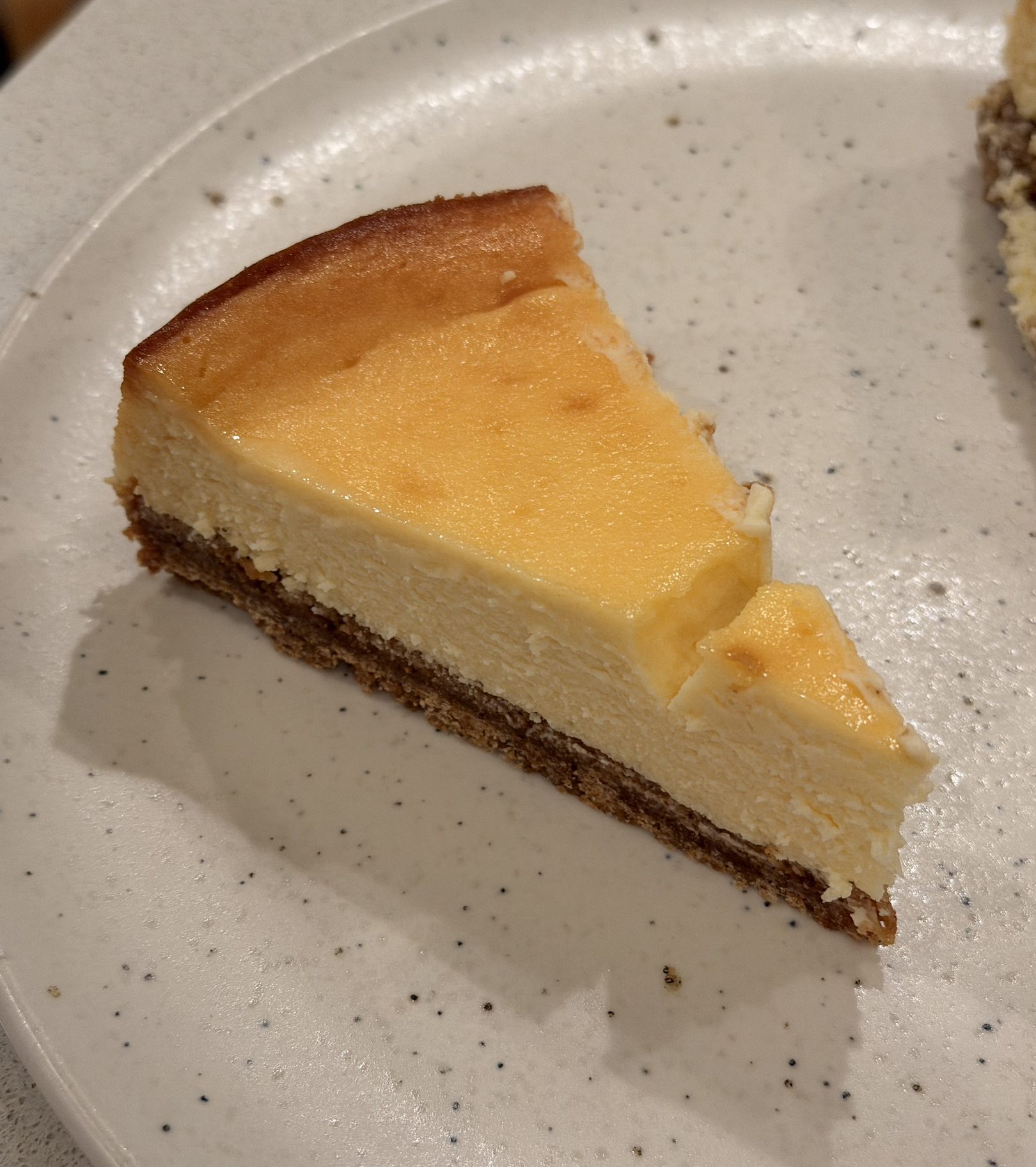
The most expensive ingredient in this recipe is time. The foundation of this cheesecake is my twice-baked shortbread cookies, which are made into crumbs to form the crust. The shortbread dough requires an overnight rest, and then it needs to be baked, rested, sliced, baked again, and cured in the open air before it can be crushed into crumbs and pressed into the springform pan. The cheesecake batter comes together in a mere few minutes, but cheesecake too requires a lot of rest; after baking it must cool slowly in the oven until it reaches room temperature, and after that it requires an overnight rest in the fridge to achieve its optimum flavor and texture.
It does not do to cheat fate. Since Saturn is the God of Time, and his core lesson for us is that patience pays, I always suggest making this cheesecake in devotion to him and offering him the first slice. This recipe is a spiritual lesson.
For the crust:
Twice-Baked Shortbread
This recipe makes enough cookies for a proper thick crust, which means that if you like, you can set some cookies aside for enjoyment while you await your cheesecake – you’ll still have crust in abundance.
This recipe is adapted from Smitten Kitchen; I believe the original version comes from Alice Medrich’s book Pure Dessert.
Ingredients
50 g maple sugar or brown sugar
80 g golden or white cane sugar (plus an extra handful for dusting)
310 g Red Tail Grains’ Miller’s Choice OR 210 g all-purpose flour and 100 g stone-ground cornmeal
285 g salted or demisel butter (use the best quality you can find; I’m partial to Banner Butter)
Method
Line a 9 × 13 inch baking pan with parchment paper.
Combine the sugars and flours in a mixing bowl. Make sure there are no lumps.
Melt the butter in a saucepan. Try not to let it brown.
Pour the melted butter into the mixing bowl and stir until the dry ingredients are all properly hydrated. Don’t overmix.
Tip the shortbread dough into the parchment-lined baking pan and press down into an even layer with your fingers. It doesn’t need to be perfect, a little inconsistency can actually be great for the flavor later on.
Scatter just enough sugar across the top of the dough to give the cookies a little sparkle.
Rest the dough on the countertop for a minimum of 12 hours. Do not try to rush the process. This step dissolves the sugar and hydrates the flour, which drastically changes the texture of the finished cookie. This does matter even though they are destined to be turned into crumbs.
The next day, preheat the oven to 300˚F.
Bake the entire tray of shortbread for 40 minutes.
Rest the tray of shortbread at room temperature for 20 minutes, keeping the oven on.
Lift the parchment paper out of the 9 × 13 pan and transfer the entire slab of cookie onto a baking sheet.
Slice the shortbread into individual cookies. I like to start by slicing the dough lengthwise into four strips, then slicing the strips crosswise into thin fingers. Usually I end up with 70-80 pieces. You want the cookies to be mostly edge and not very much middle, because they will brown the best that way and become more flavorful.
Spread the cookies out on the pan so there’s a little space between each of them – they’re fragile at this stage so be gentle. If some of them break, it’s not a big deal.
Place the cookie sheet in the oven and bake for another 40 minutes.
Once the cookies are finished baking, let them sit in the open air overnight. Try one cookie just after baking when they’re super dry from the oven, and then try another cookie every few hours and you’ll see that they improve in texture as they cure in the humid air. If you have a screened-in porch, you can speed up the process by allowing them to cure outside; I suggest covering them loosely with a cloth if you do this so they don’t get dusty.
If you’re going to make the cheesecake as soon as the cookies are properly cured, take this moment to bring your crème fraîche, cream cheese, and eggs out of the fridge so they can come to room temperature overnight.
Cheesecake
Ingredients
At least ¾ of your batch of twice-baked shortbread
8 oz tub crème fraîche (I use Vermont Creamery)
200 g caster sugar (I use Judee’s)
3 8 oz blocks of cream cheese (I use Tillamook)
3 eggs (I use Vital Farms’ restorative eggs)
Method
This recipe requires all your ingredients to be at room temperature. I mean it.
Preheat the oven to 350˚F. Place one oven rack in the center of your oven and another close to the bottom.
Butter the inside of a 9 or 10 inch springform pan (be abundant). Cut a circle of parchment paper and place it on the bottom of the pan, then butter that too.
Wrap a layer of aluminum foil around the outside of the springform pan. It doesn’t need to be watertight, the goal is to keep the butter in the cookies from leaking all over the floor of your oven.
Place the shortbread cookies in a ziploc bag and crush them evenly with a rolling pin. It’s okay if a few chunks remain.
Pour all the crumbs into a springform pan (mine is 9 inches but you can go wider if you like) and spread them into an even layer. Press the layer down firmly with a flat-bottomed glass until they form a coherent layer. Don’t pack them too tightly or they’ll be hard to cut through, but too loose isn’t great either. Be like Goldilocks and feel it out.
In a mixing bowl, combine the crème fraîche, sugar, and cream cheese. Mix them together until no lumps remain. This is the part that simply won’t happen if the ingredients are cold. Take care not to beat air into the batter or your cheesecake will come out looking hideous because of all the bubbles.
Incorporate the eggs into the batter one at a time, continuing to take care not to beat in any air.
Pour the batter into the springform pan. Then drop the pan onto the counter from a height of about four inches. Do this several times to bring all the bubbles to the surface. Pop the bubbles with a toothpick. Repeat until no more bubbles come up.
Bring a kettleful of water to a boil. Pour the hot water into a 9 × 13 inch pan until it’s ½ to 1 inch deep. Place this pan on the lower oven rack.
Place the cheesecake on the center oven rack. Bake for 55-75 minutes, or until the edges of the cheesecake pull away from the sides of the pan but the center is still jiggly. Do not overbake your cheesecake or it will be grainy in texture! If you’re feeling insecure about whether it’s done or not, it’s better to err on the side of underbaking it.
Do not take the cheesecake out of the oven. Turn the oven off, and prop it open a crack using a folded up kitchen towel or an oven mitt. Allow the cheesecake to cool inside the oven until the air in the oven feels like it’s at room temperature.
At this point the cheesecake will still be warm, but you can take it out of the oven. Allow it to continue cooling at room temperature until you can touch the bottom of the pan and feel that it is completely cooled through.
Move the cheesecake to the fridge and let it cool there for an absolute minimum of six hours. Tepid cheesecake is disgusting.
When the cheesecake is properly cooled, remove the aluminum foil from the pan. Run a knife all around the edges of the pan, making sure to reach all the way to the bottom. Release the sides of the pan.
Slice the cheesecake with a warm, wet knife for best results. If you, like Saturn, care about quality standards and aesthetics, wash the residue off the knife after every cut so it doesn’t build up on the edges of your cake slices.
It’s standard to offer the first fruits of everything you make to the Gods out of respect. But in the case of cheesecake, often the first slice out of the pan is a mess, because you need to break into the crust and it usually crumbles when you try to lift it out. Use your judgment – if the second slice is much more beautiful than the first, offer that one instead, but be sure you don’t take a bite out of your first slice until it’s on the altar and you’ve lit the candle.
