
Sephie and I are getting to know each other on the fast track, and she found out recently that biscuits (American South style, flaky with buttermilk) are like, a personality thing for me, so we’ve been eating a bunch of different ones and talking about them. Tonight under Pluto square Venus Rx, she asked me to make her homemade biscuits that I thought she would like.
Have I mentioned that I’m autistic? Probably. My two biggest special interests are recipe development via ingredient substitution and mythological food symbolism. So this was not a hard challenge as Oracle work goes. Cooking for the Old Gods is literally what I’m for.
My favorite base recipe for small-batch biscuits came from the Southern Living website, but I can’t find it there anymore. I don’t know how faithful I’ve been anyway – I’ve been working from memory for two years and I am not a reliable narrator.
For Sephie I wanted to incorporate one of my special cornmeals, which I buy from Red Tail Grains, my local grain-to-mill-to-bakery guys at the farmers market. I asked her to choose between Cateto and Bloody Butcher; she chose the latter and was very vocal about her excitement. I thought it made sense that an heirloom of Bloody Butcher’s stature would appeal to her, and I really do recommend trying to get your hands on it for this recipe. It’s available for shipping at the link! You have no excuses.
I thought it made sense to use wildflower honey instead of my usual handful of golden sugar. I’m partial to the wildflower honey from Flamingo Estate because it’s texturally thin and mixes into doughs really easily. It also tastes distinctly different each season, and that brings the Earth goddess worship to the next level.
One day I’m going to have a garden, and maybe I’ll even have bees of my own when they have enough nice things to feed on. But until then, someone else’s honey harvest will do.
I know it’s theoretically best to use local honey, but stuff here just isn’t as flavorful as the FE harvest. Baking for Sephie, my sensory seeker? I use the loud honey.
Mise en place
60 g salted Kerrygold butter (for melting)
Dry Mix
120 g sprouted all-purpose flour OR 90 g all-purpose flour and 30 g malt powder (not the same as malted milk powder)
60 g Bloody Butcher cornmeal (or the best cornmeal you can get, do not use masa)
pinch salt
½ tablespoon baking POWDER, not SODA
60 g fridge-cold salted Kerrygold butter, cut into small dice
Wet ingredients
30 g wildflower honey
120 g whole cultured buttermilk
Method
Preheat the oven to 450˚F. If you have a baking steel, place it on the center rack and move any other oven racks below so they’re out of the way.
Preheat your baking pan of choice. The most traditional would be a small cast iron skillet. You could also use a baking sheet. With biscuits you have to make your own executive decisions based on what you have; in poverty cooking nothing is “wrong.”
In a small skillet, melt the butter designated under Mise.
Mix all the dry ingredients in a mixing bowl until well combined.
Scatter the cold butter across the surface of the dry ingredients and toss gently until each piece of butter is coated in flour. Try to break apart pieces that are stuck together without warming them up too much.
Using a smushing motion with your fingers, work the butter into the flour mixture until the biggest pieces are pea sized. At this point the flour mixture should hold together somewhat if you squeeze it in your hand.
Drizzle the honey over the surface of the dry mixture. Try not to pool it. Then pour in the buttermilk.
Mix everything together as minimally as you can, just trying to get all the dry bits hydrated. Expect the dough to be craggy. Don’t overmix or your biscuits will be tough. I use my hand to do this because utensils require me to put the dough through a lot more agony.
Scatter about ½ cup of cornmeal across your working surface.
Swipe all the biscuit dough out of the mixing bowl and pat it into more or less a square puck. Coat it in cornmeal on both sides.
Working quickly and not being perfectionistic:
In a few movements, pat the dough out, keeping it in a square shape, until it is about one inch thick.
With a sharp knife, slice the square of dough into four smaller squares. Stack the four squares, pat them until they cohere, and then coat both sides of the new piece of dough in cornmeal.
Repeat these two steps four times, creating sixteen layers of dough.
When you have your final mass of dough, pat it out again until it’s about one inch thick. Then divide it into pieces according to your preference. I like to use a one and a half inch diameter round biscuit cutter, and I get ten or eleven pieces if I rework the offcuts wisely. You can also make the entire mass of dough into a single cathead biscuit, or cut it in four to achieve a small dinner roll size. Do your thing.
If you’re using a walled pan, coat the bottom and sides with the melted butter you prepared earlier. Then tuck the biscuits into the pan so they’re all nestled up against each other. This is the ideal situation for biscuits. It’s okay if they’re really smushed.
Once they’re all in there, brush the tops with melted butter.
If you’re using a baking sheet, lay parchment paper down before placing your biscuits about two inches apart so they have room to expand. Brush melted butter over the tops. The biscuits will be more like scones and there’s nothing you can do about that. It’s fine, it’s not wrong, it’s the buttermilk that makes it a biscuit.
Either way, place the biscuits in the oven, ideally on your baking steel if you have one, and set the timer for 11 minutes. They may need more time depending on the size and depending on your oven’s personality. The longest I typically let mine go is 14.
As soon a the biscuits come out of the oven, brush the tops with butter again. This is imperative.
Eat them when they’re still warm from the oven. Finish the whole batch before the day is over. I manage to get this done as a one-person household; that’s why making biscuits is a special occasion and not something I do every day even though it’s quick and easy.
If you really can’t eat all the biscuits in one day, only bake half of them. Freeze the other half.
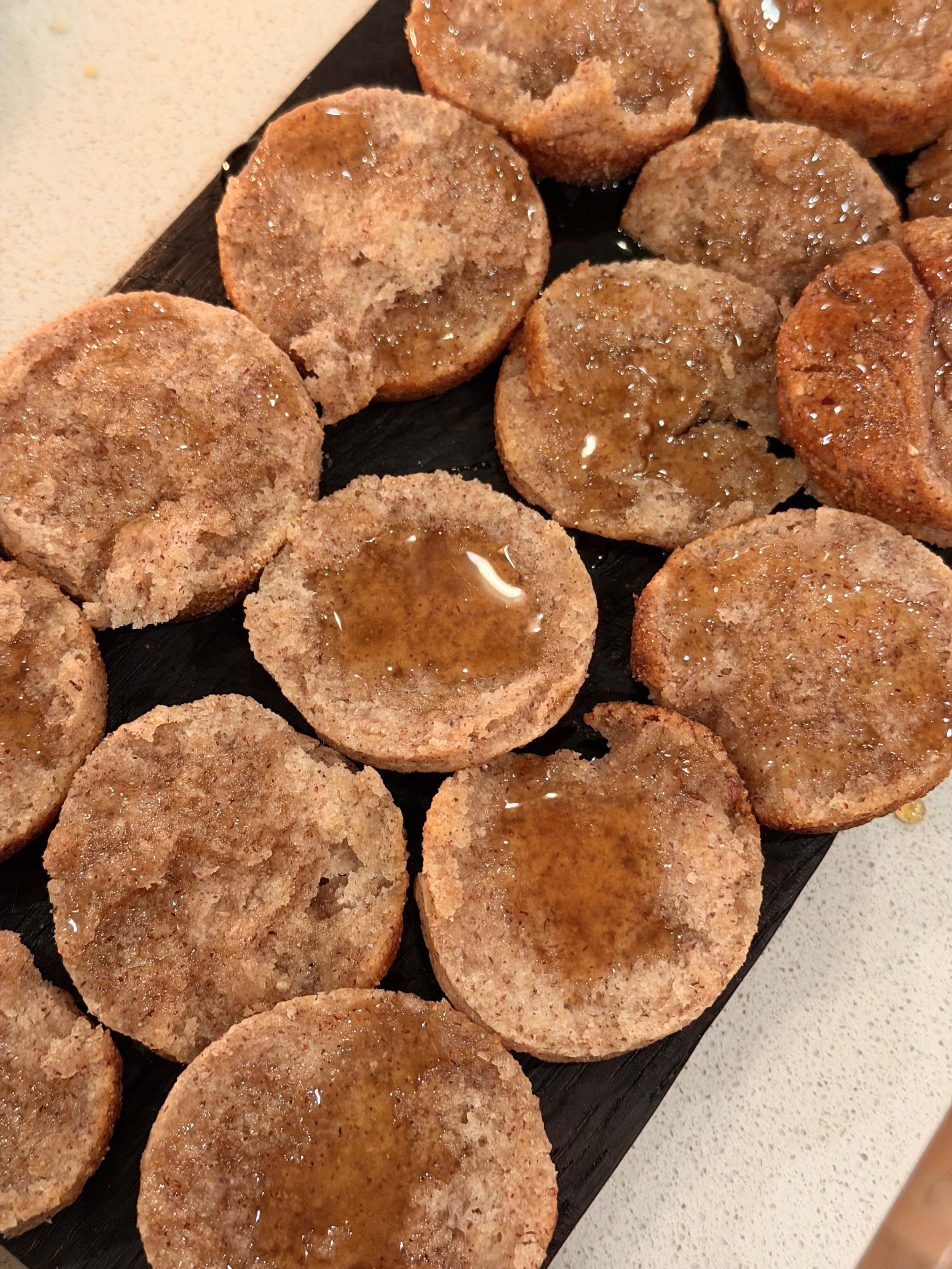
I served the biscuits halved laterally and drizzled with Flamingo Estate’s wildflower honey until saturated, as shown.
They are not that sweet on their own, and would probably go well with anything that you’d pair with cornbread, or even just plain with butter and jam.
Next time I’ll serve them with
Eggs baked in parmigiano cream:
Keep the oven at 450˚F.
In a measuring cup, mix about ¾ cup heavy cream with 1 minced clove of garlic, heavy pinch of salt, grind of black pepper, and a fair amount of microplaned parmigiano. Pour this mixture into a gratin pan and crack in two eggs (I use Vital Farms Restorative).
Place in the oven. For runny eggs, start checking at 6 minutes. For medium eggs, maybe 8 or 9. But it really depends on your oven and your preference.
