
I’m going to offer this herbal tea for purchase when I open the store, but I don’t want you to have to give me money for this stuff. Here’s the exact recipe I use to make it, complete with the link to my vendor.
If you’ve bought this herbal nerve tonic and loved it, don’t keep paying me for more! Get the ingredients to make your own. You’ll save on my shop markup, and we’ll reduce our net gas emissions by cutting down on shipping.
CAVEAT AND WARNING: I’m not a DOCTOR, and I don’t KNOW you. In this recipe and its notes, I’m just telling you what I do for myself. If you are a person who sees doctors, you don’t have to ask your doctor before trying this herbal blend at all ever, but I would talk to them if you plan to start using it every day regular.
Be responsible when you’re using herbs. If you take any meds, look up the interactions for every herb BEFORE you put in your body. I’m not saying don’t try things, I’m saying that it’s possible to know in advance exactly what you’re about to go through, and therefore if you don’t do it you’re neglecting your self-care duty.
What is Magic Hat Nerve Tonic? It’s a simple herbal tea designed to firmly, yet gently downregulate the nervous system without putting you to sleep. The key ingredient is skullcap, which protects the crown chakra (making us less vulnerable to pressure) and disengages the fight or fight response. Many people also experience the sensation of wearing an invisible hat, almost like a magical thinking cap.
Skullcap doesn’t make bad feelings go away. But it can help us regulate our fear response to those bad feelings so we can approach them with a clear head. If you’re sober when you drink it, you will find the sensory changes in your body very subtle. Symptoms of your bad feelings won’t go away at first, but the feeling of grounded agency will quickly come back to you, allowing you to focus on other things until the discomfort fades into the background.
The other ingredients are there to support (lemongrass – clarifying) and counterpoint (ginger – activating) so the energy of this tea comes through as balanced in the system.
Be aware – if you mix herbs with other intoxicants like alcohol or cannabis, you may experience the skullcap more intensely.
Ingredients
4 oz dried organic ginger root (if using conventional ginger, add more to compensate for milder flavor)
1 oz dried skullcap
3 oz dried lemongrass
(optional) 0.2-0.5 oz dried calendula
(optional) 1-2 oz dried damiana
(optional) 4 oz dried fruit, sliced into small pieces
Vendors
I buy everything I can from Starwest Botanicals. They are consistent and reliable. I like that they run out of stock in popular items when it’s not growing season, it gives me a feeling of trust.
They do not have damiana. I haven’t found a consistent vendor yet that I’m willing to link here.
For the shop, and for my own use, I dehydrate my own fruits in house. I buy organic for this purpose when I can, but it’s not always possible, for example when I’m shopping at the Asian grocery store I don’t expect to find organic labels. If you can’t dry your own fruits, make a point of reading the ingredient labels before buying something to use in this tea – you’d be surprised at the additives you’ll find. I suggest finding something sugar-free and preservative-free.
Method
In a large bowl, weigh all the ingredients and mix them together.
For the shop, I make the version without the optional ingredients. For myself, I keep a variety of iterations in stock so I have exactly what I need when the mood strikes.
I don’t usually use all three optional ingredients in the same batch because I’m a minimal taster, but do what’s right for you!
Package the herbal blend in labeled airtight containers. For my own storage I use the same heat seal bags as I use for the shop. I find that bugs always manage to get into my glass storage jars, but they never get into these bags.
I get my rice paper heat seal bags here. You’d be surprised how useful they are once you have them.
Preparing the Tisane
1-2 tablespoons herbal blend (more if you’re feeling worse)
Boiling water
(Optional) Honey to taste
Add the herbs to your teapot. The minimum amount to get a good dose is about 1 tablespoon of herbal blend. You can go as much as ¼ cup if you’re really having a tough time. I routinely use ¼ cup of herbs to get myself to sleep while hypomanic.
Pour boiling water over all the herbs, making sure they all get saturated and there are no dry pockets. Give everything a good swirl before putting on the lid.
Set a timer for fifteen minutes while the herbs steep. This is a great moment to knock out a meditation. If you can’t root yourself into a seated meditation, do a cleaning and tidying meditation. Wander around your home aimlessly, looking for stuff you can put away. Be with the frenetic energy and find a productive purpose for it.
Pour the herbal tisane into your vessel of choice. I strongly recommend using your favorite cup. Do you have a special cup that you feel comforted by holding in your hands when it’s full of warm tea? If you don’t have one yet, I suggest looking out for the perfect cup while you’re out in the world.
Sweeten to taste; I strongly suggest using honey instead of sugar. Tea with honey is the traditional panacea of grandmothers all over the world for a reason.
Notes on the optional ingredients
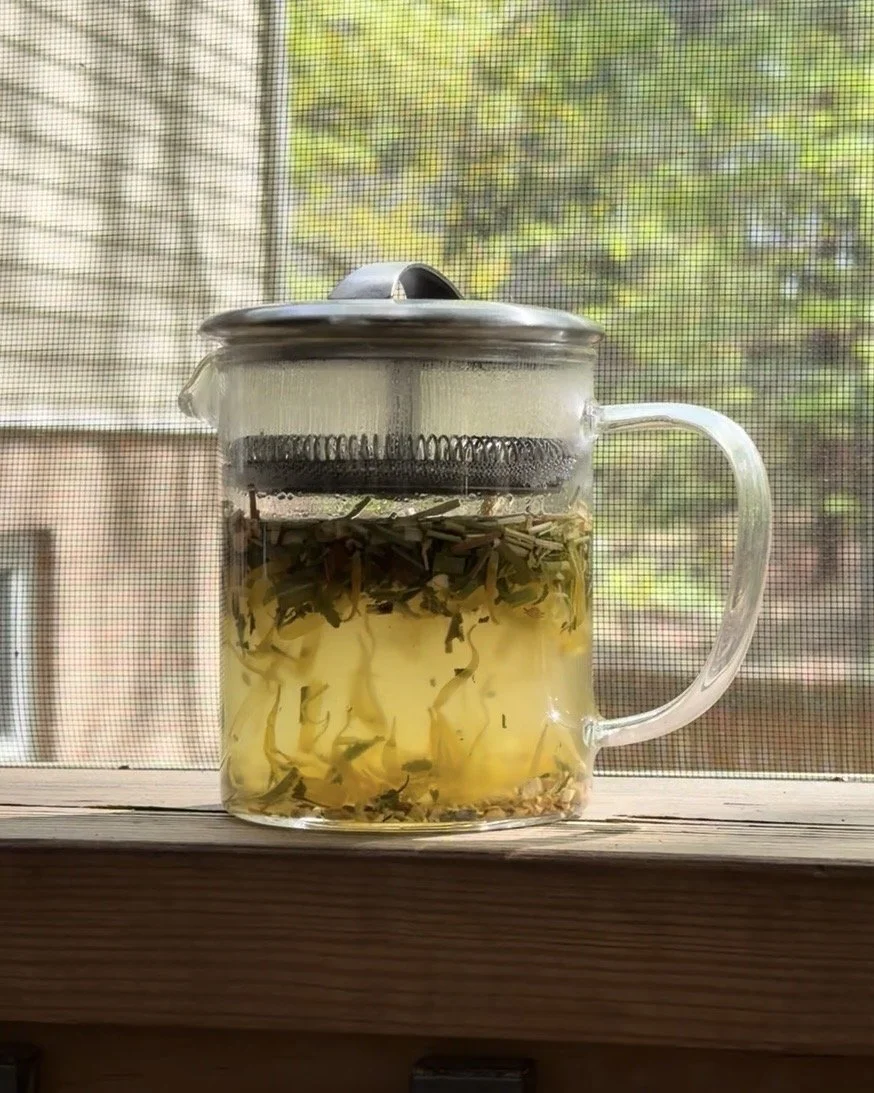
Calendula can function as a preservative, and it adds color and a sweet floral note to the tea. If you’re making a huge batch of tea and plan to go through it slowly, you might want to add this so that it “stays fresh” for longer. I don’t know how it works, I just know that it does work. Calendula is also great to add if you’re looking for a more involved sensory engagement ritual. Use a glass teapot – it’s beautiful to watch the petals drift in the water.
Damiana is a sacral chakra activator, and sacral energy is what we rely on to get anything done in life. This herb has a reputation for being an aphrodisiac, but this is a reductive take rooted in the racism of Spanish colonizers. Like, yes, damiana can be used as an aphrodisiac if you use it a certain way. But that’s not intrinsically what it does to your body. All damiana really does is add energy to your system and improve the health of your flow. When I was struggling with depression and chronic fatigue and needed a boost to my baseline energy, and I had already maxed out the amount of caffeine I could consume without negative side effects, damiana was a great daily medicine.
Dried fruit can add flavor, magical symbolism, and nutrients to your herbal tea. If you feel like you’re foggy in the brain, maybe what you actually need is more micronutrients. Depending on the season and my body experience, my favorite fruit additions are lemon, mango, peach, and pineapple. I’m a sour flavors person, though – you may crave something sweeter like a berry.
